
Thai vs Egyptian Blue Lotus: A Clear Guide to Authenticity, Origin, and Market Confusion
“Is this real Blue Lotus?”
If you’ve been researching Blue Lotus, you’ve probably come across a mix of information; different botanical names, different origins, and different claims about what is considered “authentic.”
Some sources say the common purple thai Blue Lotus is not the same as the Egyptian one. Others suggest everything on the market is essentially the same plant. You may also have noticed that many “Egyptian” Blue Lotus products are not grown in Egypt at all.
So what is actually going on?
This article is here to bring clarity; from a botanical, sourcing, and product-quality perspective.
The first distinction: there isn’t just one “Blue Lotus” on the market
The term Blue Lotus is used broadly, but in practice it usually refers to two closely related botanical identities:
Nymphaea nouchali var. caerulea
→ the most widely available and commercially used Blue Lotus todayNymphaea caerulea
→ the traditional Egyptian Blue Lotus, historically depicted in ancient Egypt
In many commercial contexts, these names are used interchangeably, which is where much of the confusion begins.
From a strict botanical perspective, the relationship between these names is complex and not always treated consistently across databases, for many different reasons. However, from a sourcing and product standpoint, the distinction is still meaningful.
The modern market: why the Thai/Sri Lankan variety is so common
The Blue Lotus most encountered on the market today, typically cultivated in South-East Asian countries like Thailand and Sri Lanka, is the standard commercial variety.
It is:
widely cultivated
consistently available
stable in quality
used across herbal products, teas, and formulations
This makes it the foundation of the modern Blue Lotus market.
Its accessibility is not a flaw, it is simply the result of where cultivation is viable today. Tropical and subtropical regions like Southeast Asia offer the right growing conditions, infrastructure, and scale.
So what is meant by “Egyptian Blue Lotus”?
When people refer to “Egyptian Blue Lotus,” they are usually referring to Nymphaea caerulea in its historical context.
This is the flower depicted in:
temple art
ceremonial scenes
ancient Egyptian symbolism related to rebirth, consciousness, and the sun cycle
However, an important clarification:
“Egyptian” does not necessarily mean grown in Egypt today.
In most cases, it refers to:
the species identity or lineage, and
the plant’s historical and cultural association
Modern cultivation on a large scale is most active in South-East Asia, where conditions are more suitable for reliable and sustainable production.
Where confusion begins: taxonomy, sourcing, and market language
One of the most common misunderstandings is assuming that “ If it’s not grown in Egypt, it cannot be authentic Egyptian Blue Lotus.”.
In reality, these are two separate things:
Botanical identity (what species it is)
Cultivation origin (where it is grown)
A plant can belong to a species historically associated with Egypt, while being cultivated elsewhere.
And not only, other sources of confusion arise from the fact that:
botanical classification is not always presented consistently across sources
closely related water lilies share overlapping characteristics
commercial naming often simplifies complex botanical relationships
What matters is transparency:
Is the botanical name clearly stated?
Is the country of origin disclosed?
Is the product positioned honestly?
Differences in availability & CHEMISTRY
From a sourcing perspective, there are clear differences between the two types commonly offered on the market.
Nymphaea nouchali variety caerulea (Thai / Sri Lankan)
high availability
consistent supply
widely used across brands
more economical
suited for everyday use
Nymphaea caerulea (Egyptian)
botanically identified as the species used in Ancient Egypt
significantly rarer
more limited supply
often positioned as a premium botanical
associated with higher concentrations of key alkaloids such as nuciferine (depending on batch and source)
more often used intentionally or ceremonially
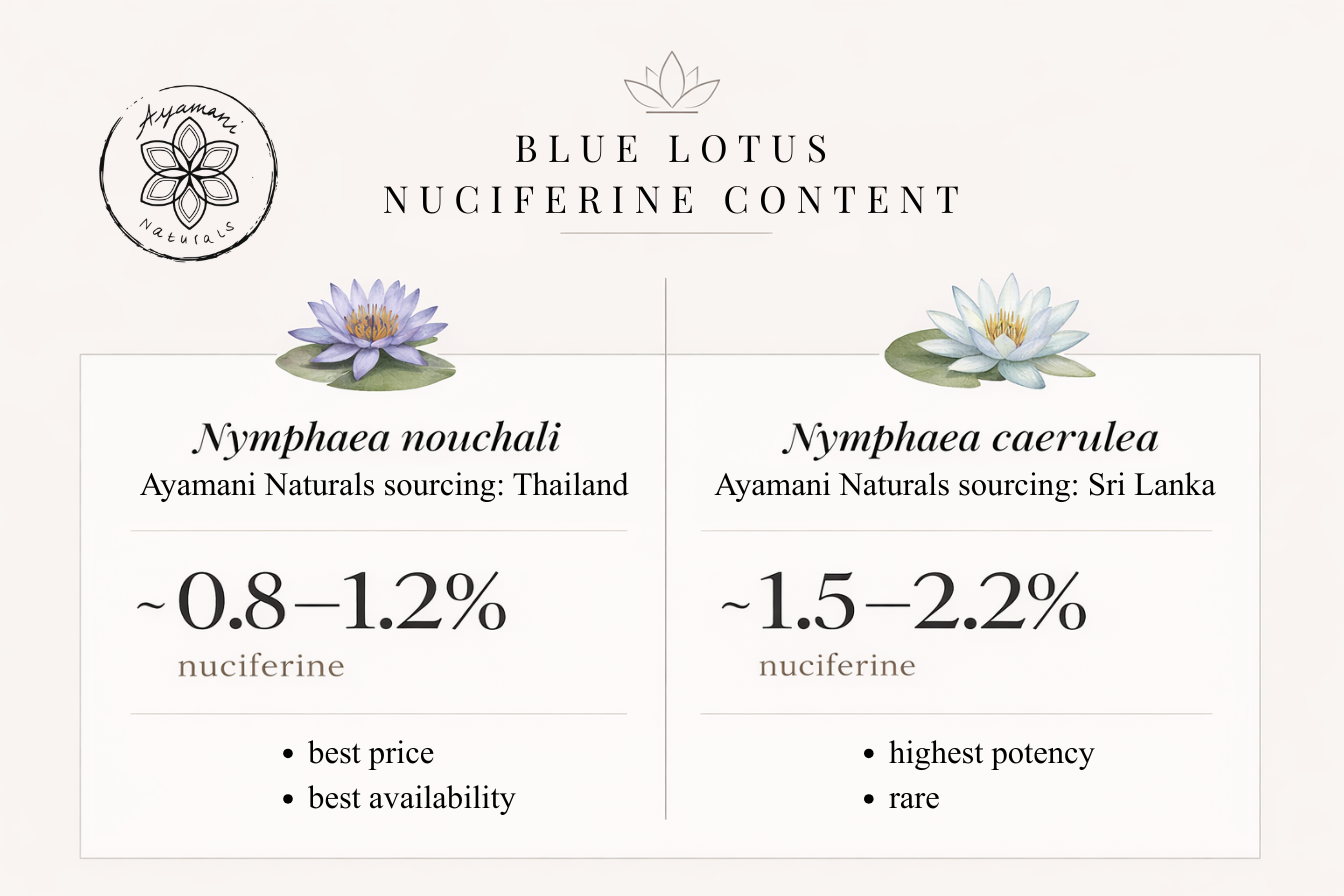
Main differences between the common and authentic egyptian blue lotus, in a nutshell
Because of this, the Egyptian variety is typically more expensive, not simply due to branding, but due to scarcity, sourcing difficulty, and selection.
Some suppliers al report differences in alkaloid content, particularly nuciferine, which one of the compounds associated with the plant’s characteristic effects.
At the same time, scientific analysis shows that chemical composition can vary significantly across samples, depending on factors such as cultivation conditions, processing, and plant selection.
This means that differences are not purely about species names, but also about quality, sourcing, and batch variability.
What recent research suggests
Recent analytical work, including research connected to UC Berkeley, has explored the differences between verified Egyptian Blue Lotus samples and commonly available commercial material.
These comparisons have suggested that:
the Egyptian Blue Lotus is a very specific plant with a distinct profile
some commercial products differ notably in composition
verified samples may show higher concentrations of key compounds such as nuciferine
At the same time, this does not mean that all commonly available Blue Lotus is invalid, rather, it highlights that:
not all Blue Lotus on the market is identical in composition or effect.
Why the Egyptian variety is more expensive
The price difference between common Blue Lotus and Egyptian-type material is primarily driven by:
scarcity (lower availability)
selective sourcing and grading
higher demand for historically associated material
and in some cases, reported differences in chemical profile
In other words, the difference is not only branding — it reflects supply dynamics and product positioning.
What about potency and effects?
Both varieties are traditionally associated with:
relaxation
mild mood elevation
sensory softening
dream-related and introspective states
However, many experienced users and suppliers report that:
the common variety tends to feel softer and more grounding
the Egyptian variety may feel deeper, more immersive, or more pronounced
It’s important to approach these differences with nuance. Effects can vary based on:
preparation method
dosage
individual sensitivity
and batch variation
That said, the distinction between a more everyday-use botanical and a more intentional, premium botanical is a helpful way to understand the difference.
Why pricing varies so much across the market
You may notice a wide range of pricing for Blue Lotus products.
This is influenced by:
species/type being sold
batch quality and grading
supply availability
branding and positioning
whether the product is sold in small retail quantities or bulk
The common variety is priced as an accessible herbal product, while rarer Egyptian-type material is priced more like a specialty botanical.
So which one is real? what do i choose?
The question is not whether one is “real” and the other is not, as there isn’t a single “better” option, but rather which is the most appropriate one depending on your intention (and let’s be honest, your budget).
If you’re looking for a reliable, accessible, everyday Blue Lotus
→ the common blue lotus (nouchali) variety is idealIf you’re seeking a rarer, more historically rooted and a deeper experience
→ the authentic Nymphaea caerulea may be worth exploring
Many people choose to work with both, depending on context.
Final note: what matters most is clarity
The Blue Lotus market can feel confusing, but the core principles are simple:
know the botanical name
understand where it is grown
be aware of how it is positioned
and choose based on your intention, not just the label
At Ayamani Naturals, transparency around sourcing and botanical identity is a priority, so you can make an informed, grounded choice.
Interesting sources:
